
Chandeliers vs. Pendants vs. Statement Sconces: What to Choose
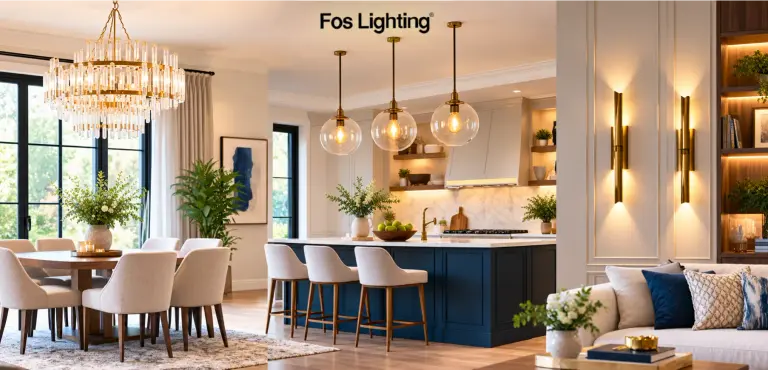
Choosing a decorative light isn't simply picking the design you like most. A chandelier looks beautiful in a large room but can overpower a small one; a pendant shines over a dining table, while a statement sconce often suits an ordinary wall better than a big ceiling fixture.
At ++Fos Lighting++, we see it differently: lighting should suit the room first and make a statement second. If you've been searching for statement lighting for your home, here's a simple way to choose between the three.
Chandelier, Pendant or Sconce: Which Does What?
There's no single winner — each fixture serves a purpose.
| | | | | ---------------- | ----------------------------------------------- | --------------------------------------------------------- | | Fixture | What It Does | Best Placed | | Chandelier | Makes a statement; catches the eye from below | Spacious living rooms, high ceilings, foyers | | Pendant | Versatile, focused light; use alone or in a row | Dining tables, kitchen islands, bedsides, reading corners | | Statement sconce | Soft wall light with no floor footprint | Beside mirrors, art, beds, consoles and passages |
OUR SIMPLE RULE Choose the light by the job it needs to do, not just by how attractive it looks on its own.
Explore the ++chandelier++, ++pendant++ and ++wall sconce++ collections to see the range for each.
Living Room: Chandelier or Pendant?
If the living room has enough space, a ++chandelier++ is usually the best choice — it adds one distinct feature that draws every eye. With high ceilings and spread-out furniture, a larger chandelier becomes the main element without crowding the room.
Start by considering room size, ceiling height and furniture placement. If the room already has bold furniture, rugs or artwork, a simpler chandelier fits better. In a small living room, a pendant is often the smarter pick — it works beautifully over a seating corner or side table without dominating the space. For sizing a chandelier correctly, see our ++room-by-room chandelier guide++.
Are Pendant Lights Better for Smaller Homes?
They can be. Pendants are one of the easiest ways to add personality without using much visual space. A single pendant over a dining table defines the dining area; two or three over a kitchen counter give a neat, finished look; one beside a chair creates a cosy reading corner. That makes ++pendants++ especially useful where space has to work harder. Our ++guide to overhead lighting with chandeliers and pendants++ goes deeper on this.
What About Festive Pendant Lights?
Festivals are a good reason to have fun with lighting. A festive pendant brings warmth during Diwali without changing your whole room. One note of caution: if the pendant has a striking shape or finish, let it lead — don't crowd it with too much extra light around it.
Where to Use Statement Sconces
A wall doesn't only need pictures — sometimes it just needs the right light. Statement ++sconces++ suit walls near mirrors, consoles, corridors and the sides of a bed, and they can highlight a wall texture or a favourite picture. Our favourite approach is symmetry: a matching pair on either side of a wall creates a decorated effect without crowding it. They're also ideal where there's no room for a ceiling fixture. For more on this, see our ++accent lighting guide++.
Entrance & Foyer Lighting
The entrance deserves more attention than it usually gets — it's the first thing people see, so the light should feel welcoming rather than merely bright. A pendant works in a covered entrance with enough ceiling height; wall sconces suit a narrow entrance; a chandelier makes a larger entrance feel special. Look at the entrance from outside too: the light should look good switched on in the evening and still feel connected to the home's style.
For a foyer, start by asking what you want people to notice first — the console, a mirror, artwork, or the entrance itself. A pendant or chandelier can provide the main light while a sconce highlights one feature. Keeping the foyer slightly softer than the main living area creates a natural transition through the home.
Find your entrance centrepiece ++➜ Shop Chandeliers++
Can You Combine Chandeliers, Pendants and Sconces?
Absolutely — it's often the best way to create a finished lighting plan. A chandelier anchors the living room, pendants define the dining area, and sconces bring softer light to a passage or wall. The trick is to connect them through one shared detail — a similar finish, shape or light colour. They don't need to be identical. Done well, this is where statement lighting becomes more than decoration: it creates flow from one space to another.
Our Expert Rule: Start With the Room, Not the Light
This is the most useful rule we can share: don't buy the light first and force the room to work around it. Look at the furniture, ceiling, wall colours, room size and natural light, then decide whether the space needs a centrepiece, focused light or a softer wall glow. Check the light colour too — warm light makes wood, fabric and warm-toned interiors feel inviting, while brighter, cooler light suits areas where clear visibility matters. The fitting and the light source need to work together.
If you need a focal point, start with ++chandeliers++; for focused or flexible light, ++pendants++; and if the walls need personality, ++statement sconces++. The best light isn't the largest or brightest — it's the one that feels right in the space. Good lighting shouldn't compete with your home; it should complete it.
Not sure which to choose?
Chandeliers, pendants & sconces · handcrafted in Chandni Chowk · shipped across India
++➜ Shop Chandeliers++ ++➜ Talk to a Lighting Expert++
Frequently Asked Questions
Which is better for a living room — a chandelier or a pendant?
A chandelier suits a spacious living room with high ceilings, where it becomes a focal point. A pendant is better for a smaller living room or over a specific spot like a seating corner, where it adds character without dominating.
Are pendant lights good for small homes?
Yes. Pendants add personality without taking up visual space — a single pendant can define a dining area or a reading corner. They're one of the most space-efficient ways to add decorative light.
Where should statement sconces go?
Beside mirrors, consoles, artwork, beds and along passages. A matching pair either side of a wall creates a balanced, decorated effect, and sconces are ideal where there's no room for a ceiling fixture.
Can I mix chandeliers, pendants and sconces in one home?
Yes, and it often looks best. Let a chandelier anchor the living room, pendants define the dining area and sconces soften a passage. Connect them with one shared detail — a finish, shape or light colour — rather than making them identical.